You need cash, and your mutual funds are right there. Selling feels like the obvious move: the money is yours, and a few clicks turns units into rupees. But selling is one of the most expensive ways to raise cash from a portfolio you still want to keep, and most of that cost is hidden.
The alternative is to borrow against your units instead of selling them. This guide lays out the true cost of each approach, with a worked example, so you can tell when to sell and when to borrow.
The hidden cost of selling
Selling looks free because no lender charges you interest. But it carries three costs that rarely show up until later:
- Capital gains tax. Selling a fund at a profit is a taxable event. Equity short-term gains are taxed at 20%, and long-term gains at 12.5% above a Rs 1.25 lakh annual exemption.
- Lost compounding. The units you sell stop growing. For a long-term portfolio, that forgone growth usually dwarfs any interest you would have paid to borrow.
- It is irreversible. Once sold, getting back in means new money, a new purchase date, and possibly a higher price. You cannot simply undo the redemption.
And selling is not even fast. A mutual fund redemption typically takes 2 to 5 business days to reach your bank. For the full tax breakdown, see our guide on capital gains tax on mutual funds.
How borrowing against your funds works instead
Check your credit limit on Volt Money. Free, takes 15 seconds.
Check your limit →A loan against mutual funds lets you pledge your units as collateral and draw a credit line against them without selling. Nothing is redeemed, so there is no capital gains event, and your units remain invested and continue to participate in market movements.
On Volt Money you can borrow from 9.99% p.a. with a limit of up to 85% of your portfolio value (up to 45% for equity funds), pay interest only on what you draw, and open your loan account in under 10 minutes with instant withdrawals thereafter. It is a 6-year credit line, so you repay when it suits you, with zero foreclosure charges.
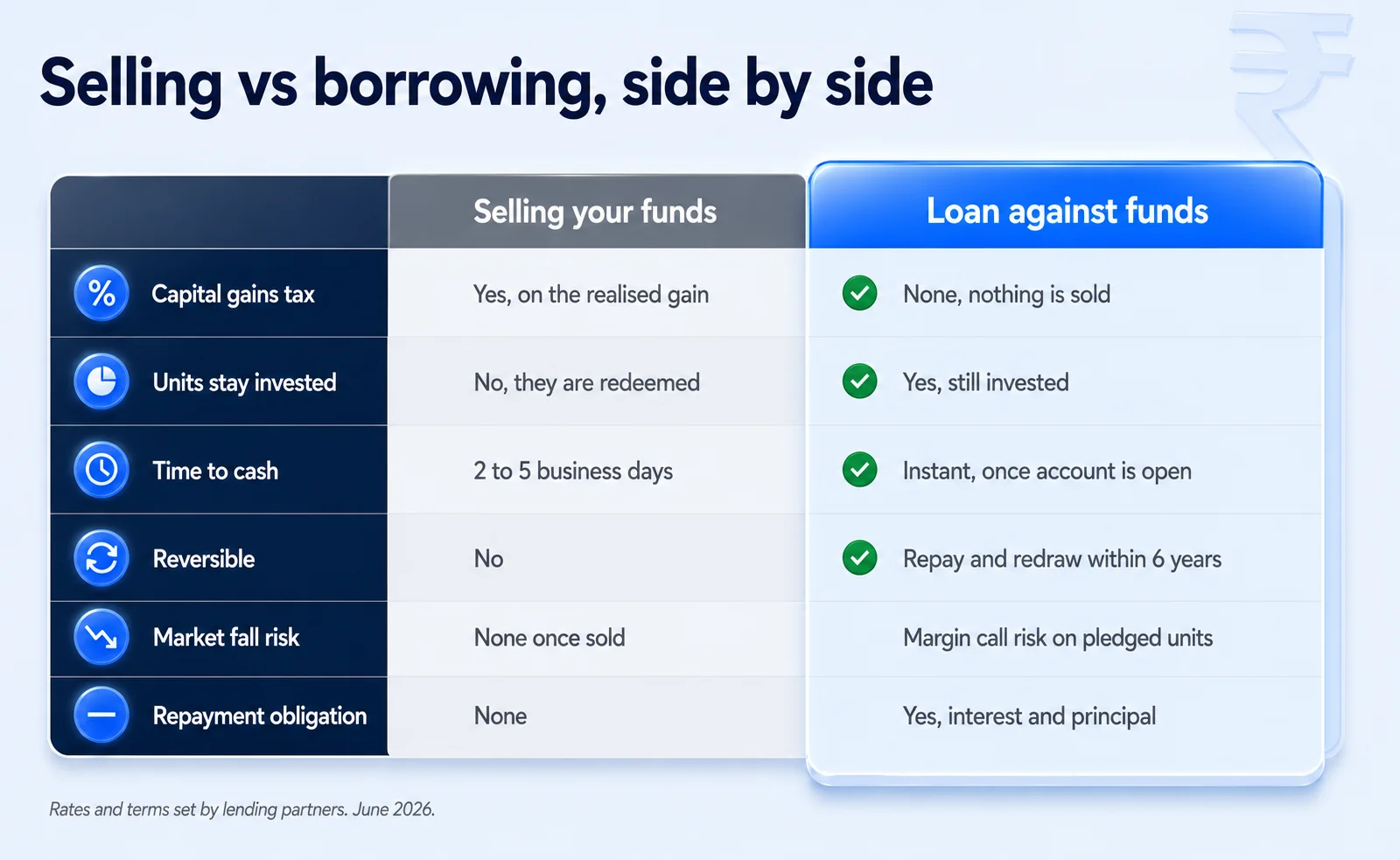
Side by side
| Selling your mutual funds | Loan against mutual funds | |
|---|---|---|
| Capital gains tax | Yes, on the realised gain | None, nothing is sold |
| Units stay invested | No | Yes, they remain invested |
| Time to cash | 2 to 5 business days to settle | Instant withdrawals once the account is open |
| Cost | Tax plus lost future growth | Interest from 9.99% p.a. on the drawn amount |
| Reversible | No | Yes, repay and redraw within 6 years |
| Credit score needed | Not applicable | None, the loan is secured |
| Market fall risk | None once the units are sold | Margin call risk if pledged units fall in value |
| Repayment obligation | None | Yes, interest and principal to manage |
A worked example: raising Rs 3 lakh
Say you hold Rs 10 lakh in equity mutual funds bought for Rs 6 lakh, and you need Rs 3 lakh for four months.
- If you sell Rs 3 lakh of units: part of that is gain, so you pay capital gains tax on it, you permanently remove Rs 3 lakh from the market, and you lose all future growth on it. At 12% a year, Rs 3 lakh could have grown by well over Rs 1 lakh across the next few years.
- If you borrow Rs 3 lakh: interest at 9.99% p.a. for four months is roughly Rs 10,000, charged only on the drawn amount. No capital gains tax at the time of borrowing, and your Rs 10 lakh portfolio remains invested.
For a temporary need against a portfolio you want to keep, borrowing is both cheaper and reversible. For many temporary cash needs, the interest cost may be lower than the tax impact and lost compounding from selling.
Tax treatment of borrowing
The money you borrow is not taxable, because it is a loan and not income, and since no units are sold there is no capital gains tax when you draw it. Interest paid is generally not tax-deductible for personal use. If you later redeem the pledged units, voluntarily or after a default, capital gains tax can apply at that point based on the fund type, holding period, and gain, at the current post-2024-Budget rates.
Risks of borrowing against mutual funds
Borrowing keeps your portfolio invested, but it is not risk-free. If the market falls sharply, the value of your pledged units drops and your loan-to-value ratio can cross the lender's limit. You may then get a margin call asking you to repay part of the loan or pledge more units, and if you do not act, the lender can redeem or liquidate pledged units to recover the dues. This is why it is safer to borrow well below your approved limit than to draw the full amount. For how your units stay protected, see is Volt Money safe.
When selling is the right call
Borrowing is not always better. Selling makes sense when:
- You no longer want to hold the fund, or you are rebalancing your portfolio on purpose.
- The goal you were investing for has actually arrived, and this money was always meant to fund it.
- Your gains fall within the annual exemption, so the tax cost of selling is minimal.
- You need more cash than your portfolio can support as a loan.
The key is to separate two questions. "Do I want to exit this investment?" and "Do I need cash for a while?" are not the same. If the answer to the first is no, selling to solve the second is usually the wrong tool.
Should you sell your mutual funds or take a loan?
Choose a loan against mutual funds if the need is temporary, you still want to hold your investments, and you can repay comfortably. Choose selling if the need is permanent, you no longer want the fund, you are rebalancing, or you would rather have no repayment obligation. Put simply, borrow when you need liquidity, and sell when you genuinely want to exit the investment.
Keep your investments. Borrow against them.
Check your credit limit on Volt Money. Free, takes 15 seconds. Check your credit limit
The bottom line
If you still believe in your investments and simply need cash for a while, a loan against mutual funds is often the better choice. It keeps your units invested, triggers no capital gains tax, costs only interest on what you draw, and can be reversed by repaying. Sell when you genuinely want out of the investment. Borrow when you just need liquidity.