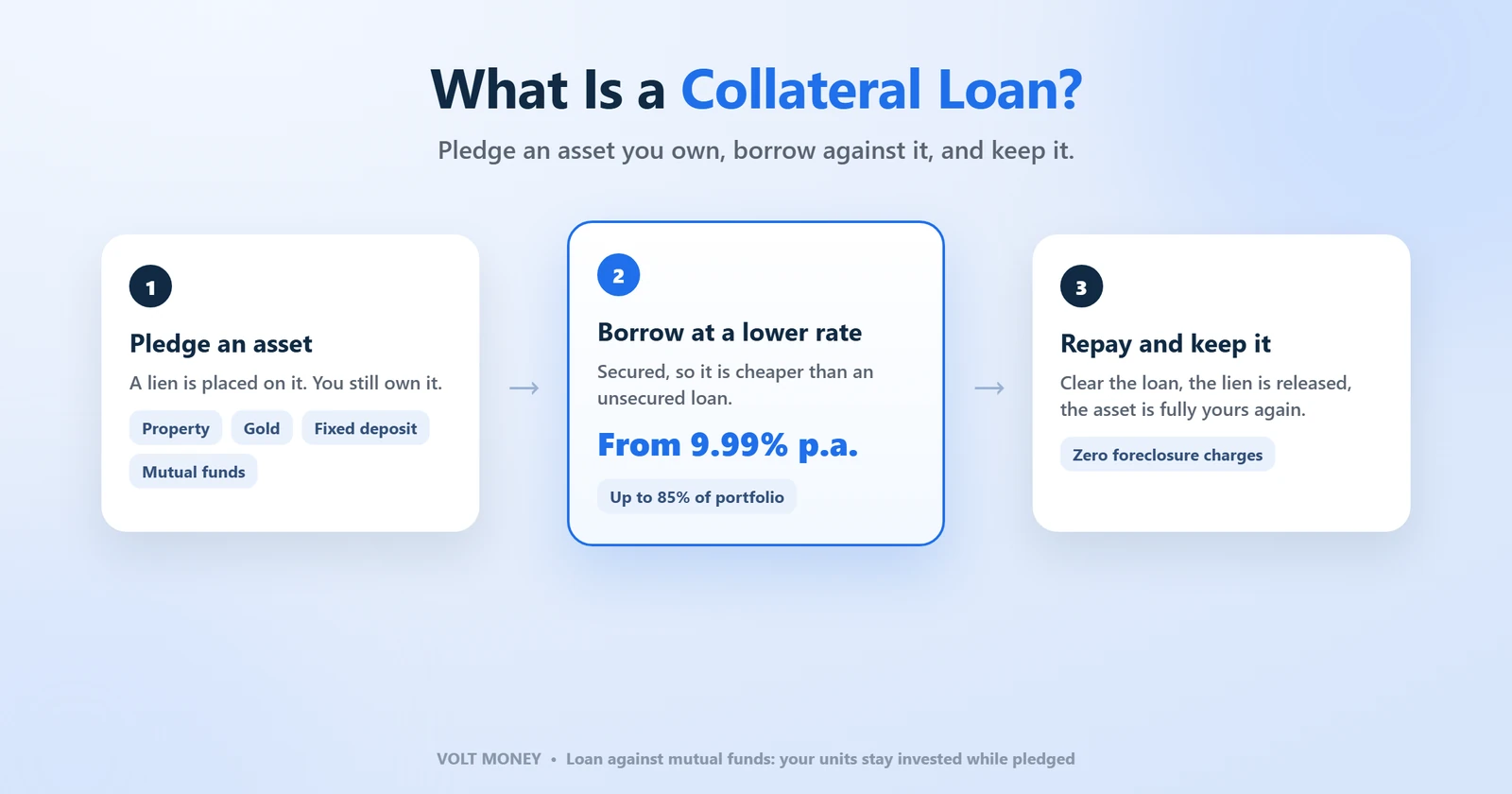
A collateral loan is a loan backed by something you own. You pledge an asset (a house, gold, a fixed deposit, or your investments) and the lender gives you money against it. If you repay as agreed, you keep the asset. If you default, the lender can recover the debt from that asset. In plain terms, the collateral is the lender security, and that security is what makes the loan cheaper for you.
Here's how collateral loans work, the common types in India, where they beat unsecured borrowing, and a worked example using one of the most flexible options: a loan against mutual funds.
How a collateral loan works
Every collateral loan follows the same basic shape:
- You pledge an asset. The lender places a legal claim (a lien or charge) on it so it cannot be sold or transferred while the loan is open.
- The lender sets a loan-to-value (LTV) ratio. You can borrow only a percentage of the asset value, keeping a cushion in case the asset falls in price.
- You get funds at a lower rate. Because the loan is secured, the interest rate is usually well below an unsecured loan.
- You repay, and the claim is released. Once the loan is cleared and you request it, the lien is removed and your asset is fully yours again.
How much can you borrow against collateral?
Check your credit limit on Volt Money. Free, takes 15 seconds.
Check your limit →How much you can borrow depends on the asset's market value and the lender's loan-to-value (LTV) ratio. A property may support a different LTV than gold, a fixed deposit, or mutual funds. In a loan against mutual funds, your eligible amount depends on the current value of your units, the type of fund pledged, the applicable LTV, and the lender's policy. Equity funds usually carry a lower LTV than debt or liquid funds because they move more with the market.
On Volt Money, you can borrow up to 45% of the value of equity mutual funds and up to 85% of debt or liquid funds, with an overall sanctioned limit up to 85% of your portfolio.
Secured vs unsecured loans
The opposite of a collateral loan is an unsecured loan, like a personal loan or a credit card, where nothing is pledged. The trade-off is straightforward:
| Collateral (secured) loan | Unsecured loan | |
|---|---|---|
| Backed by an asset | Yes | No |
| Typical interest rate | Lower | Higher |
| Depends on credit score | Less, or not at all | Heavily |
| How much you can borrow | Tied to asset value | Tied to income and credit profile |
| Risk to you | You can lose the pledged asset | No asset at stake, but higher cost |
Primary security vs collateral security
You may also come across the terms primary security and collateral security. In everyday use, people say collateral to mean any asset pledged for a loan. Technically, primary security is the asset created directly from the loan, such as a home bought with a home loan, while collateral security is an additional asset pledged to support repayment. In a loan against mutual funds, your units act as the security for the loan.
What can be used as collateral?
Common collateral includes property, gold, fixed deposits, vehicles, machinery, shares, bonds, mutual fund units, and other financial securities. The lender checks the asset's value, how easily it can be sold, and its risk before deciding how much to lend against it. Market-linked assets like mutual funds and shares are usually lent against at a percentage of their current value, keeping a cushion for price swings.
Common types of collateral loans in India
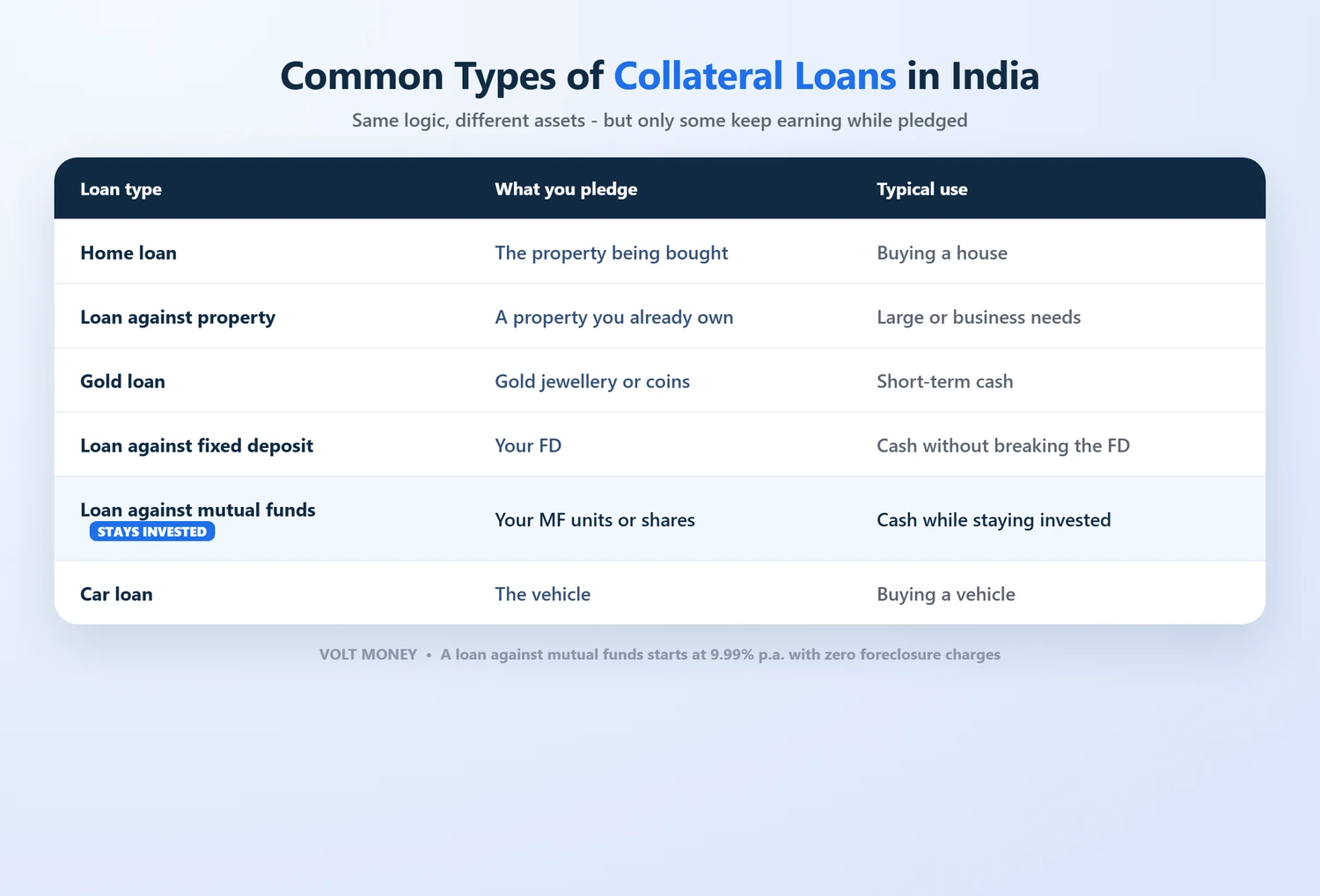
| Loan type | What you pledge | Typical use |
|---|---|---|
| Home loan | The property being bought | Buying a house |
| Loan against property (LAP) | A property you already own | Large or business needs |
| Gold loan | Gold jewellery or coins | Short-term cash |
| Loan against fixed deposit | Your FD | Cash without breaking the FD |
| Loan against mutual funds / securities | Your MF units or shares | Cash while staying invested |
| Car loan | The vehicle | Buying a vehicle |
They all share the same logic, but they behave very differently on speed, flexibility, and whether the pledged asset keeps earning for you while it is locked. That last point is where a loan against mutual funds stands apart.
A worked example: a loan against mutual funds
Say you hold Rs 10 lakh in equity mutual funds and need Rs 4 lakh for a few months. Instead of selling, you pledge your units as collateral.
Your limit: at up to 45% LTV on equity funds, a Rs 10 lakh portfolio supports a credit line of up to Rs 4.5 lakh. You draw the Rs 4 lakh you need.
Your cost: interest from 9.99% p.a., charged only on the Rs 4 lakh you actually drew, calculated daily. You are not charged on the unused Rs 3 lakh.
Your asset: the units remain invested and continue to participate in market movements. The lien only stops you from redeeming them, not from market-linked gains or losses.
If your portfolio was built through SIPs, the loan is not against your future SIP instalments. It is against the mutual fund units your SIP has already accumulated, and your ongoing SIP can continue as usual while those pledged units stay invested.
That is the advantage of pledging a productive asset. With a gold loan your gold sits idle in a vault. With a loan against mutual funds, your collateral remains invested instead of being redeemed.
What charges should you check?
Before taking any collateral loan, look at the full cost, not just the interest rate: the processing fee, any valuation or documentation charges, foreclosure or prepayment charges, and penalties for late repayment. On Volt Money, the processing fee starts from Rs 999, interest starts from 9.99% p.a., and there are zero foreclosure charges.
The pros and cons of collateral loans
Advantages:
- Lower interest rates than unsecured loans, because the lender risk is covered.
- Access to larger amounts, tied to your asset value.
- Often available even with a weak or thin credit history, since the asset does the reassuring.
Things to weigh:
- Your asset is at stake if you default, so borrow within your means.
- Asset-linked limits can move. If the pledged asset falls in value, you may face a margin call to top up.
- The asset is locked from sale until you clear the loan and release the lien.
- Default can cost you the asset. If you fail to repay or do not meet a margin call, the lender can sell or liquidate the pledged asset, including mutual fund units, to recover the outstanding dues.
See what your investments can unlock
Check your credit limit on Volt Money. Free, takes 15 seconds. Check your credit limit
The bottom line
A collateral loan trades a pledged asset for cheaper, larger, more accessible credit. The best type depends on what you own and how much flexibility you want. If your asset is a mutual fund portfolio, a loan against those units is one of the most efficient choices, because you get low-cost credit while your money remains invested and retains its long-term compounding potential.
Rates, limits, and charges are subject to change and are set out in your Key Facts Statement before you borrow.